ANY QUESTIONS? TEL:+8653286101152 | EMAIL: info@smad.com.cn



ANY QUESTIONS? TEL:+8653286101152 | EMAIL: info@smad.com.cn

We will contact you within 12 hours.
November 18, 2026 / Industry News
Everything a professional buyer needs from Black Friday 2026 follows from one sentence: the season is getting longer and thinner at the same time. Longer — because the promotional calendar has stretched across fifteen weeks. Thinner — because component costs are capping how deep anyone can afford to go. Here is what that means behind the scenes.
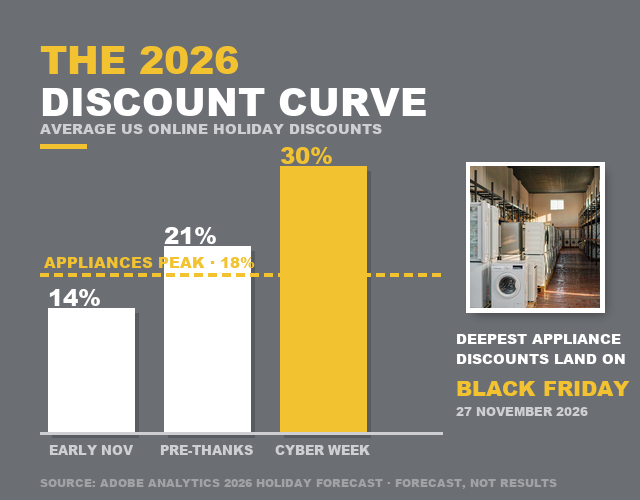
Black Friday is no longer a Friday
The industry numbers make this plain. In 2025, the fourth quarter generated 28.4% of annual global revenue for the tech and durables industry, with October and November alone accounting for 16.1% — and October, not December, has now become the single largest sales month of the year. The seven largest promotional events together stretch across roughly 15 weeks and represent about 35% of global annual revenue, according to industry data compiled by GFU with NIQ.
Adobe's own forecast confirms the same drift in the US: October pre-season online spending is projected at $95.8 billion, up 8% — bigger than most countries' entire annual e-commerce market, spent before Thanksgiving.
And the earliest leading indicator this year was cautious. Across 13 markets, October's second Prime Day week fell 1.7% in sales value and 2.7% in units against a record 2025 — telecom and small domestic appliances beat last year, while IT and consumer electronics lost double digits.
The practical conclusion for anyone buying appliance inventory: the one-big-weekend inventory bet is dead. A supplier or retailer who loads warehouses for a single Friday and goes quiet in December is competing against a calendar that no longer exists.
Here is the number that should reorder your marketing budget: during Black Friday 2025, 16% of purchasers globally used AI tools as part of their purchase journey — four percentage points above the quarterly average. For Q4 2026, global AI usage across the purchase journey is expected to jump from 12% to more than 22%. Adobe separately forecasts a 130% year-over-year surge in AI-driven traffic to US retail sites.
Meanwhile, the decision window keeps stretching: the average path from decision to purchase during Black Friday now runs 19 days, versus 15 days across the full fourth quarter. Shoppers are not impulse-buying a refrigerator. They are researching, comparing, and asking an assistant to shortlist it.
What that means commercially is simple and slightly uncomfortable: visibility in AI-generated recommendations is becoming as important as visibility on the physical shelf. And AI assistants read structured product data — specifications, energy classes, dimensions, availability — not marketing copy. The companies that invested in clean, machine-readable product files this year will quietly win shortlists the others never see.
This connects directly to the compliance work already on your desk. The product data the EU's Digital Product Passport requires — the same structured dataset we walked through in our piece on the 31 December ESPR deadline — is largely the same dataset AI discovery engines want to read. You are not building two data systems. You are building one, for two audiences: regulators and algorithms.
The biggest risk this Black Friday is not discounting too little.
It is reading a record forecast as a demand signal.
Every November, the headlines say "record spending," and every year the record is partly inflation, partly population, partly pull-forward from January. A forecast of $1.013 trillion spread across a stretched fifteen-week season is not the same animal as a record concentrated in one weekend — and appliance demand, more than most categories, still answers to housing turnover and replacement cycles, not to promotional calendars. Treat the five days as data. Treat the headlines as noise.
If this season has a lesson, it is that the price on a Black Friday banner is the least reliable number in it. The reliable ones live in a quotation: the delivery lead time behind it, the compliance file that ships with the goods.
Our quotation season is open now. Contact us your SKU list and target volumes, and we will come back with a quote that states the delivery window, the post-transition EU compliance documentation, and the price-validity terms in writing...
The 18% Ceiling: What Black Friday 2026 Actually Means for Appliance Sellers November 18, 2026
Navigating the 2026 German Heat Pump Subsidies: A 70% Opportunity for Your Business Oct. 28, 2026
A Distributor’s Guide to the Most Profitable Commercial Refrigeration Niches in 2026 Oct. 24, 2026

 No.2 Heilongjiang South Road, Shibei District, Qingdao, China.
©️ 2020 Copyright Qingdao Smad Electric Appliances Co., Ltd. All rights reserved | Privacy Policy | Powered by Linkjoint.